Top Takeaways
>> Natural diamonds are associated with mining, environmental damage, human rights abuses and war.
>> Lab grown diamonds are physically and chemically the same as natural diamonds.
>> Lab grown diamonds do require a lot of energy to create, but this can be done with renewable sources.
Lab grown diamonds can certainly offer a like-for-like ethical alternative to mined diamonds.
A major benefit of a lab grown diamond is that it comes without the habitat loss and environmental damage of conventional mining. Not to mention the association with human rights abuses and civil wars.
Here’s the added benefit. Whether it’s excavated out of the ground or created in a lab, a lab grown and mined diamond have the same physical and chemical properties.
Does this sound a little true good to be true? Keep on reading to find out all about lab grown diamonds.
Why are natural diamonds unethical?
Believe it or not, diamonds haven’t always been associated with jewellery and engagement rings.
It’s thought that engagement rings first came about in Ancient Rome before given official meaning by Pope Nicholas I in 850. Diamonds were used sporadically on rings by the elite of the world, but it wasn’t until the 1940s when De Beers mining company launched an ad campaign to pique the interest of unassuming consumers.
So, why are natural diamonds unethical then?
Environmental damage
It’s the process of physical diamond mining where the negative impacts come about.
Large diamond mines look a little bit like moon craters (as you can see below). To create a working mine, the local habitat has to be cleared back to the bare ground. Trees, plants and vegetation are all removed, leaving the brown soil and earth exposed.
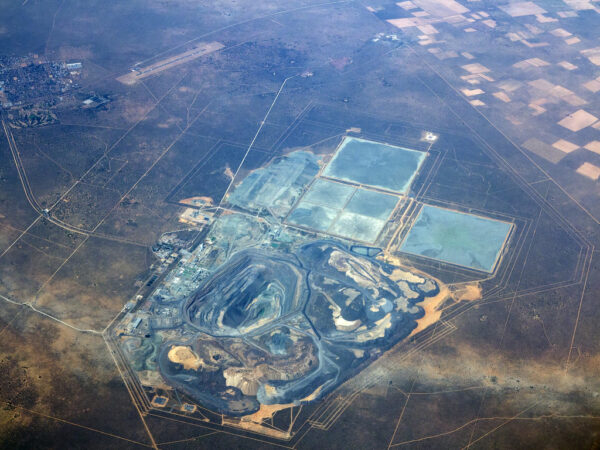
Like most big industries, diamond mines cause natural habitat destruction, species loss, soil erosion and contaminate the local water sources.
Because of the value now seen in diamonds, they have been used to fund wars, insurgencies and human rights crackdowns. This has been seen in many diamond-rich countries, such as Sierra Leone, Angola, Zimbabwe, Liberia and Democratic Republic of Congo.
What is the difference between lab grown and natural diamonds?
You may be surprised to find out that lab grown diamonds and natural diamonds are exactly the same.
If you looked at both types of diamonds side by side and under a microscope, they would appear to be identical.
Lab grown diamonds and natural diamonds share the same:
- Chemical composition
- Optical properties
- Hardness
The only difference is in the origins and were they are created – lab diamonds are grown in a laboratory and no mining is required.
How are lab grown diamonds made?
How is it possible for lab grown diamonds to be the same as natural diamonds?
Well, it all comes down to chemistry.
Diamonds are more or less formed from pure carbon whose atoms have crystallised under high heat and pressure. This can happen in nature or in the lab.
Using advanced technology, specialised laboratories can create High Pressure High Temperature (HPHT) environments to form the characteristic crystal lattice structure of diamonds. For this reason, lab grown diamonds ‘grow’ in the same way that their natural counterparts do.
With this, lab grown diamonds perform and exhibit the same brilliance and sparkle as a mined diamond.
To ensure you’re getting the best quality, you’ll want to make sure diamonds reach the industry standards set out by GIA, IGI or GCAL grading report. These cover important aspects such as the cut, colour, clarity and carat weight specifications.

Are lab grown diamonds more ethical?
Lab grown diamonds start to come into their own when we discuss ethics.
Choosing a diamond grown in the lab is a very sustainable option. One of the main reasons for its growing popularity is that lab grown diamonds make for fantastic ethical engagement rings.
Unlike traditionally mined diamonds, lab grown jewellery has a significantly smaller carbon footprint and none of the negative ethical implications that are caught up with mined diamonds and the process of getting them out of the ground.
When purchasing a lab grown diamond, traceability and transparency are also major ethical benefits when compared to mined diamonds. This is because there is a real issue when it comes to knowing exactly where a mined diamond has originated from when traditional mining practices are involved.
This is true for other lab grown gemstones, such as the gems grown for moissanite engagement rings. I actually bought an ethical engagement ring from an independent seller on Etsy UK and it’s been great.
I think it’s fair to conclude that lab grown diamonds are much more ethical than natural diamonds.
What are the benefits of lab grown diamonds?
Alongside the more ethical side, cost and affordability are other big benefits to lab grown diamonds.
Lab grown diamonds can cost around 30% less than the natural mined variety – and when you are talking about significant sums of money, 30% can be quite the saving!
So, with increased sustainability, the exact same chemical composition as mined diamonds, a reduced carbon footprint and cheaper price, there are plenty of benefits to lab grown diamonds. Perfect if you want to buy an ethical ring.
Negatives of lab grown diamonds?
While lab grown diamonds offer many benefits over mined diamonds, there are some downsides to be aware of. The main negative revolves around energy.
Growing a diamond in lab conditions requires high heat and pressure. This is created via significant energy inputs.
It’s thought it takes between 250-750 kilowatt hours (kWh) to produce one polished lab grown diamond carat. To put that into perspective, driving an electric car for 1,000 miles will require around 250kWh. For a carat of diamond, this is a lot of energy.
Data from the DeBeers group, estimate that it takes between 130-170kWh to mine a natural diamond. Although lower, it does come with the other environmental negatives as discussed.
Thankfully, lab diamond companies reduce their carbon dioxide emissions by using more renewable energy to make the process as energy efficient as possible. However, in many cases, fossil fuels are still used to generate the extreme conditions needed.
Data from the UN’s Intergovernmental Panel on Climate Change (IPCC), compare the approximate carbon dioxide emissions required to grow a 1 carat diamond:
- Coal – 205kg
- Natural Gas – 122kg
- Solar – 12kg
- Hydropower – 6kg
- Wind – 3kg
So overall, lab grown diamonds powered by renewable energy source is the most ethical and environmentally friendly version you can get.
Are lab grown diamonds the same as cubic zirconia?
Sometimes people can get confused between the different lab grown gemstones.
In this instance, no, diamonds and cubic zirconia are two entirely different gems. And in turn cubic zirconia is different from other ethical and lab grown gemstones such as moissanite.
For all these stones, the chemical and physical compositions are different.
Hopefully that gives you a clearer indication of what exactly lab grown diamonds are and how they compared to mined diamonds.
Lab grown diamonds are much more ethical than mined diamonds but offer all the benefits, plus more.
The big question that remains really is, why would you by a mined diamond when you get can a lab grown diamond that offers the same quality at a cheaper price and with greater sustainability?
If you liked that, take a look at these blogs too…