Let’s be honest about sustainable travel – it’s complicated.
Despite 68% of people planning holidays in 2025 and half claiming to consider sustainability when booking, the reality is that travel will always have some environmental impact.
Aviation alone accounts for around 60% of the emissions from international tourism and 40% of GHG emissions of overall tourism. Long-distance flights are responsible for a disproportionate share.
But here’s my take: we shouldn’t punish ourselves by not travelling at all.
Seeing different parts of the country and wider world gives us a better understanding of nature and the environment. The key is making smarter choices that genuinely reduce our impact, rather than just ticking boxes.
The Case for Staycations (And Why the UK is Underrated)

The most obvious way to cut travel emissions is staying closer to home. I’ve reviewed countless small cabins, huts and eco-stays across the UK, and honestly, we’re spoiled for choice.
Beaches in Cornwall, forests in Scotland, countryside in the Cotswolds, highlands, lakes – we’ve got everything. Check out websites like EarthStays and Host Unusual to find some great, sustainable places to stay.
The carbon savings are significant too. Trains emit 80% less carbon dioxide than airplanes, making UK destinations accessible with a fraction of the environmental cost. Of course, not all places are within touching distance of train stations but e-vehicles are making a difference here too in lowering emissions.
That said, I get why people want to travel abroad. It’s brilliant, and I’m not here to shame anyone for wanting to explore the world.
Hotel Choice: Where Your Impact Really Adds Up
If you are travelling abroad, your accommodation choice makes a massive difference – and I don’t just mean choosing somewhere with a green logo.
The all-inclusive problem I’ve stayed at all-inclusive hotels before, and the waste is staggering.

Hotels produce approximately 79,000 tonnes of food waste annually, accounting for nearly 10% of all commercial food waste globally. Food waste alone can represent 45-50% of a hotel’s total waste stream.
On average, a hotel guest generates around one kilogram of waste per night, with a significant portion being food-related. When you’re at a buffet with unlimited everything, it’s easy to see how this adds up.
If you’re looking to reduce waste, go for an apartment, villa or self-catering option. You’ll waste less food, use fewer single-use items and often save money too. It’s a win-win approach that gives you more control over your environmental impact.
When choosing accommodation with sustainability in mind, look for genuine eco-credentials. Skip the vague ‘eco-friendly’ claims and look for verified certifications like Green Seal, EarthCheck or EU Ecolabel. The hotel we stayed at in Spain this year had a Double U Certificate for circularity.
Check out this post on 10 ideas for hotels to be more sustainable.
The Small Changes That Make A Difference

One of the best features of our Spanish hotel was the water fountain on each floor and large carafe in each room.
We took our reusable bottles and didn’t buy a single plastic water bottle the entire holiday. Simple but effective.
Travel-sized toiletries are a massive source of single-use plastic. Pack refillable containers or solid alternatives where possible. This includes dental care – traditionally one of the most plastic-heavy categories.
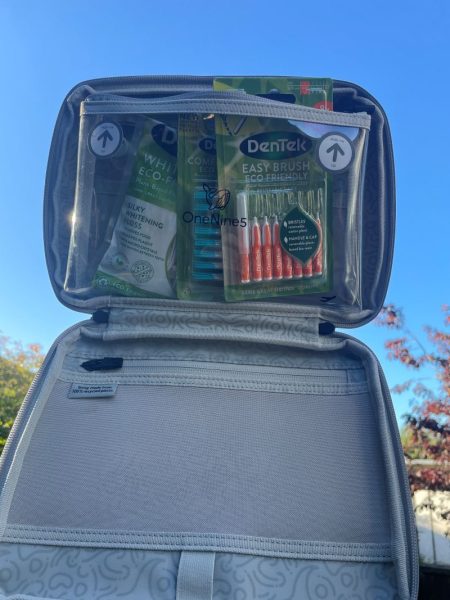
Previously, eco-friendly dental products for travel were limited, but brands like DenTek now offer bio-resin alternatives made from sugarcane that reduce carbon emissions by up to 80% compared to conventional plastic production. When you’re using floss picks and interdental brushes daily on holiday, these small switches add up.
Transport choices make a difference to. When we’re abroad, we try to:
- Hire bikes, e-scooters or walk instead of taxis
- Use public transport to explore destinations

Quick Green Travel Tips
Here’s a quick, practical list of ideas for reducing your own impact from impact:
- Choose trains, buses or e-cars over air travel whenever possible
- If flying is unavoidable, book non-stop flights (these use less fuel per kilometer than multiple flights)
- Try to use public transport, walk or cycle at your destination
- Pack light – it will make a very small impact on transport energy but more importantly it will help you avoid taking unnecessary disposable items
- Carry a reusable water bottle and fabric tote bag – always handy!
- Reuse towels and bed linens during hotel stays to minimise housekeeping
- Get rid of waste responsibly, recycle wherever possible and leave no trace at green spaces and natural areas
- Take unfinished hotel toiletries home to avoid waste
- Eat locally sourced and seasonal food
- For any trips, book with responsible tour operators that measure and offset carbon emissions and support community welfare
- Select eco-certified hotels or places with verified green credentials like Green Seal, EarthCheck, or EU Eco-label
- Check for hotels using renewable energy, avoiding single-use plastics and offering options for reusing towels and linens
- Support local accommodation providers who invest in sustainable initiatives and community projects

The Bigger Picture
Travel is never going to be perfect. For me, it’s about being mindful of your choices and their impact.
Some holidays will inevitably have a larger footprint than others, and that’s okay if you’re making conscious decisions elsewhere.
My goal isn’t to stop exploring the world, but to do it more thoughtfully. Whether that’s choosing a cabin in the Lake District over a weekend in Barcelona, staying longer when you do fly somewhere or simply being more conscious about waste during your trip. The key is finding the balance between exploration and responsibility.
This article was written in collaboration with DenTek, who are working to reduce single-plastic waste in travel-sized dental products.