Top Takeaways
>> SCOP stands for Seasonal Coefficient of Performance
>> It represents your heat pump’s year-round efficiency – a SCOP of 3.0 means you get 3kW of heat for every 1kW of electricity used. The higher the SCOP, the better.
>> Modern air source heat pumps should achieve SCOP ratings between 3.0 and 4.0
When researching heat pumps, you’ll often come across SCOP ratings. This crucial metric helps you understand how efficient a heat pump will be across the year, which ultimately leads back to how much it will cost to run.
Whilst it might seem a little technical at first, understanding SCOP is essential for making informed decisions about any potential heat pump system. So, let’s give you a quick whistlestop tour of what you need to know about SCOP and why it matters for your home heating.
What’s the Difference Between SCOP and COP?

COP = Coefficient of Performance
COP measures a heat pump’s efficiency at a specific moment in time. It’s like taking a snapshot of how well your heat pump is performing under particular conditions. For example, a COP of 3.0 means your heat pump produces 3kW of heat energy for every 1kW of electricity it uses.
SCOP = Seasonal Coefficient of Performance
SCOP gives you the bigger picture. It measures average performance across the whole season, taking into account varying outdoor temperatures, different heating demands, defrost cycles and supplementary heating needs.
Whilst heat pumps might achieve a COP of 4.0 or higher during mild weather, this can drop significantly during colder periods. SCOP accounts for these variations, giving you a more realistic view of year-round performance.
How is SCOP Calculated?
SCOP is calculated by measuring heat pump performance across different temperatures and conditions throughout the heating season. The calculation considers performance at various outdoor temperatures, local climate data, your heating system design, building heat loss and hot water production efficiency.
Modern air source heat pumps should achieve a SCOP rating between 3.0 and 4.0. For example, a heat pump with a SCOP of 3.5 will, on average, produce 3.5kW of heat for every 1kW of electricity used over the entire heating season. That’s 350% efficiency.
What is a Good SCOP Rating?
| SCOP | Efficiency | Explanation |
|---|---|---|
| Below 3.0 | Below average efficiency | Can be seen in older systems or those operating in challenging conditions. |
| 3.0 – 3.5 | Good efficiency | This is the standard range for most modern heat pumps operating under normal UK conditions. |
| 3.5 – 4.0 | Very good efficiency | Achieved by high-quality systems with optimal installation and suitable property conditions. |
| Above 4.0 | Excellent efficiency | The gold standard, often achieved in well-insulated properties with low-temperature heating systems like underfloor heating. |
Heat Pump Monitor is a great website to check out.
It’s an open-source initiative to share and compare heat pump performance data, including info from ground source and air source heat pumps. You can really dig into the weeds with all sorts of charts and dashboards.
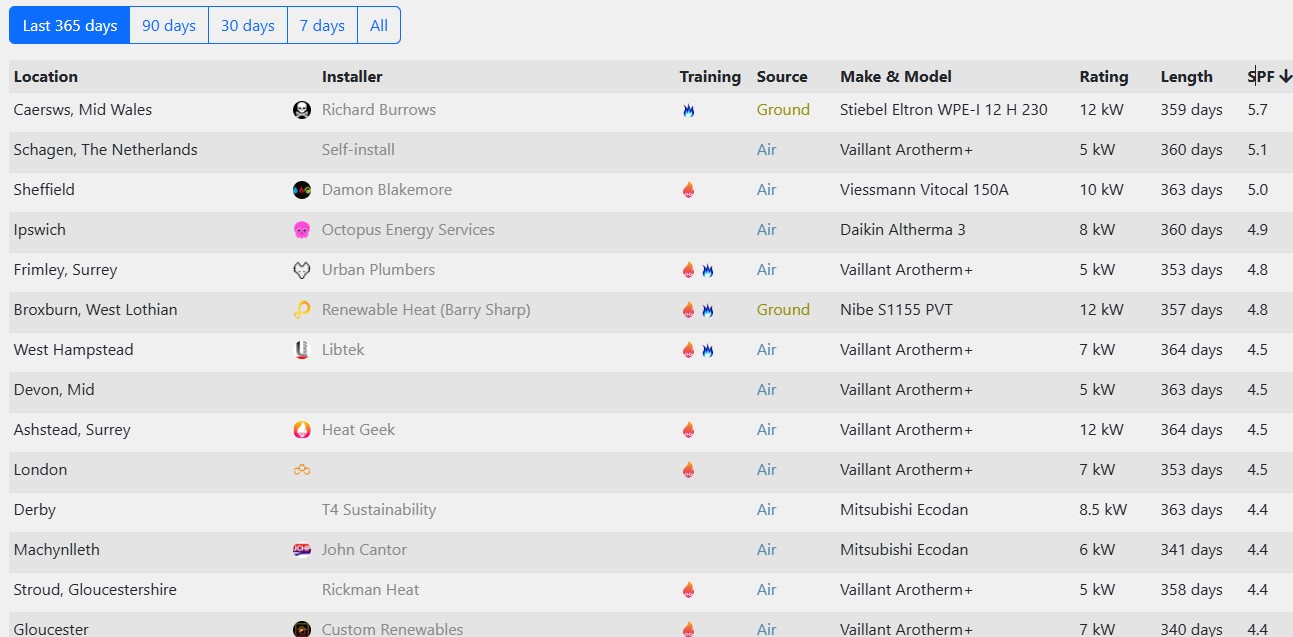
On the image above, the SCOP rating is given in the ‘SPF’ column.
As you can see, some of the popular make and model names coming up include:
- Vaillant Arotherm+
- Daikin Altherma 3
- Mitsubishi Ecodan
- Viessmann Vitocal
At bit further down, you’ll see makes and models including Samsung Gen 6, Panasonic Aquarea and Grant Aerona3, amongst others.
How SCOP Affects Running Costs
Your heat pump’s SCOP has a direct impact on your energy bills. For a standard three-bedroom house using 10,000 kWh of heating per year, the difference between a system with SCOP 3.0 and one with SCOP 4.0 is significant.
With SCOP 3.0, you’d use 3,333 kWh of electricity (10,000 ÷ 3.0) a year. At an electricity rate of 25p/kWh, this would cost £833.
The same home with a system achieving SCOP 4.0 would use only 2,500 kWh (10,000 ÷ 4.0) per year, costing £625. This represents a healthy saving of £208 per year.
You can learn more about heat pump costs here.

What factors Impact SCOP?
Climate conditions – Local weather patterns, seasonal temperature variations and humidity levels all affect your heat pump’s performance.
Installation quality – Correct sizing of a heat pump system, proper placement of the outdoor unit and optimised flow temperatures make a significant difference. Professional installation by MCS-certified engineers is crucial for achieving manufacturer-stated SCOP ratings. Take a look at trusted heat pump installers.
Property characteristics – Your home’s insulation levels, radiator sizing, building heat loss and the type of heat distribution system all influence SCOP. Well-insulated properties with appropriate radiators usually achieve higher efficiency.
Maintenance practices – Regular servicing, clean filters and optimal system settings help maintain efficiency over time. Annual professional maintenance can prevent SCOP degradation of up to 15% that occurs in neglected systems.
There can be a lot to think about, which we’ve tried to summarise in our post on are heat pumps worth it?
How Flow Temperatures Impact SCOP
Flow temperatures are important – and often argued about.
The flow temperature is the temperature of water circulating through your heating system. It’s the water that enters your radiators and comes out of your shower. It also has a significant impact on your heat pump’s SCOP.
Lower flow temperatures result in higher efficiencies. A heat pump running with a 35°C flow temperature might achieve a SCOP of 4.0, whilst the same unit operating at 55°C (needed for standard radiator systems) might only achieve a SCOP of 2.8-3.2.
This difference can translate to approximately £200-300 in additional annual running costs for a UK home.

It’s why heat pumps often work best with underfloor heating systems that can operate effectively at lower flow temperatures of around 35°C.
Some heat pumps are specifically designed to work more efficiently at higher temperatures. If you’re keeping your existing radiators, look for models optimised for higher flow temperatures or consider upgrading to larger radiators that can work effectively with lower flow temperatures.
Checklist for Maximising Your Heat Pump’s SCOP
✓ Low and slow – heat pumps work most efficiently when they’re running in the background all of the time, rather than with frequent temperature changes or setbacks
✓ Heat pumps work best in a well-insulated home
✓ Pair heat pump with appropriately sized radiators or underfloor heating
✓ Set moderate target temperatures (19-21°C) rather than high ones
✓ Set the lowest flow temperature that still provides comfort
✓ Use weather compensation controls to automatically adjust settings
✓ Schedule annual professional servicing maintenance
✓ Clean filters monthly during heating season
✓ Consider solar panels to power your heat pump during daylight hours
Making Sense of SCOP When Choosing a Heat Pump
When comparing heat pumps, look for SCOP ratings above 3.5 for best performance.
Ask your installer questions like: What SCOP can I expect in my specific situation? How will you optimise the system for maximum efficiency? What maintenance is required to maintain good SCOP?
Remember that the highest SCOP rating isn’t absolutely everything – consider installation quality, manufacturer reputation, system cost, warranty terms and installer expertise.
You can find further information on our guide to getting started with air source heat pumps.